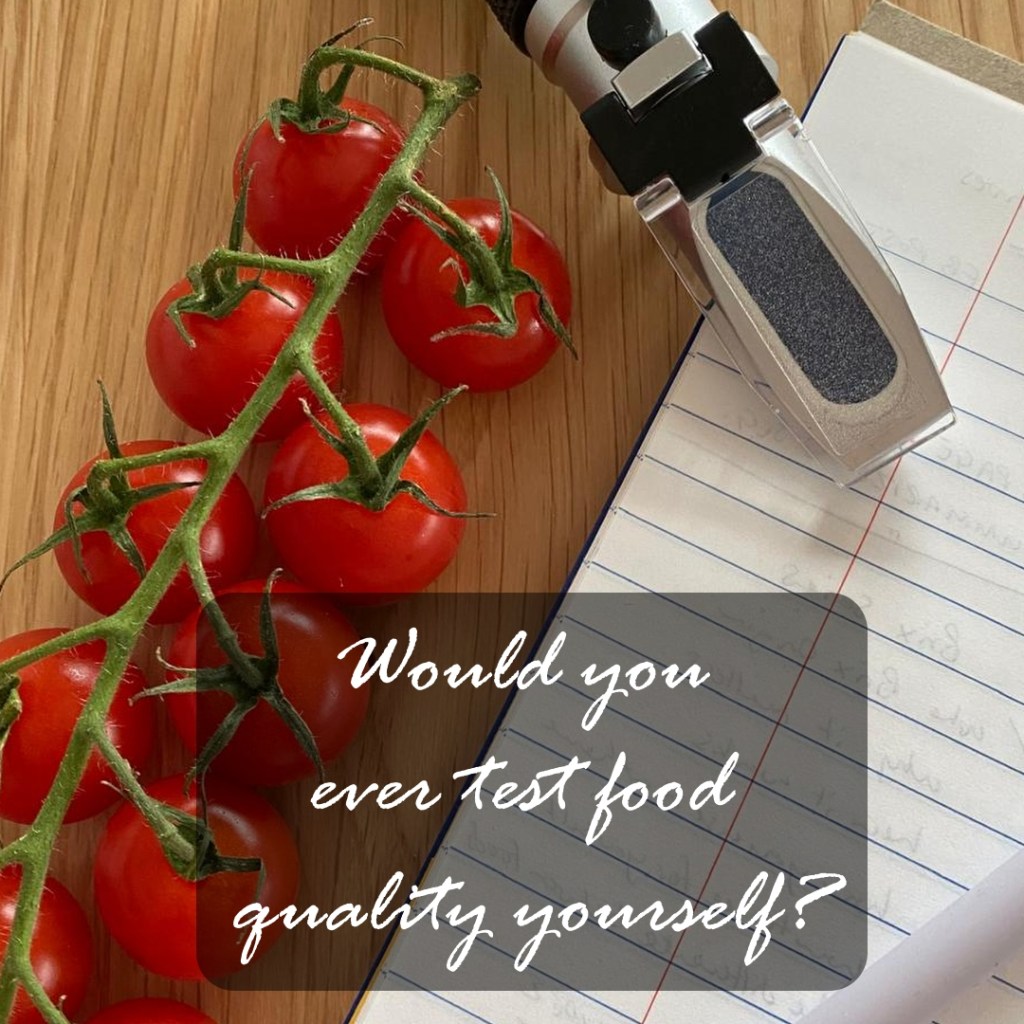
When we place a drop of juice onto a small glass prism and hold it toward the light, something quiet but remarkable happens.
A line appears.
A number reveals itself.
A measurement is made.
That small moment connects us to a scientist working in the 1800s — long before handheld refractometers, long before industrial agriculture, long before nutrient density became a modern concern.
His name was Adolf Ferdinand Wenceslaus Brix.
And the scale that bears his name still shapes how we measure sweetness — and potentially food quality — today.
Who Was Adolf Brix?
Adolf Brix was born in Germany in 1798, during a period of rapid scientific and industrial development in Europe. Sugar refining, brewing, and winemaking were expanding industries. Consistency mattered. Predictability mattered. Trade depended on it.
At the time, sugar concentration in liquids was often estimated by taste, density, or experience. But taste varies. Temperature changes density. And experience, while valuable, is difficult to standardize across regions and industries.
Brix worked to bring clarity to this problem.
Through careful experimentation, he developed a standardized way to relate sugar concentration to measurable physical properties of a solution. The unit that now bears his name — the degree Brix (°Bx) — represents:
1 gram of sucrose dissolved in 100 grams of solution.
In simple terms:
1° Brix = 1% sugar by weight.
This scale allowed producers to communicate precisely about sweetness and sugar content. It brought order to industries that depended on consistency.
Originally, sugar concentration was often measured using hydrometers — floating instruments that measured liquid density.
But another scientific development would soon change everything.
The Science of Light and Refraction
As chemistry advanced, so did optics.
Scientists discovered that light bends — or refracts — when it passes from one medium into another. When light moves from air into water, it changes direction. Add dissolved sugar to that water, and the bending changes again.
The more dissolved solids present, the more the light refracts.
This principle led to the development of the refractometer.
A refractometer measures how much light bends as it passes through a liquid sample. When a drop of juice is placed on the prism, light enters, refracts, and creates a visible boundary line inside the instrument. That boundary corresponds to a scale calibrated in degrees Brix.
What once required laboratory conditions eventually became portable. By the 20th century, handheld refractometers were widely used in vineyards and orchards.
Winemakers used Brix readings to determine harvest timing. As grapes ripen, sugar accumulates. Measuring Brix helps estimate potential alcohol levels and flavor balance.
Fruit growers use it to assess sweetness and maturity. Maple syrup producers use it to verify sugar concentration. Honey producers use it to measure moisture levels.
What began as industrial chemistry became an agricultural tool.
From Sweetness to Plant Vitality
Over time, some growers began noticing patterns.
Sugar production in plants is the result of photosynthesis. Photosynthesis depends on:
- Sunlight
- Healthy leaves
- Balanced mineral nutrition
- Active soil biology
- Efficient root systems
Healthy soil supports healthy roots.
Healthy roots absorb balanced minerals.
Balanced minerals support efficient photosynthesis.
Efficient photosynthesis increases sugar production.
While Brix directly measures dissolved solids — primarily sugars — it does not directly measure vitamins, minerals, protein, or phytonutrients.
However, sugar production is part of a plant’s metabolic system. And plant metabolism reflects growing conditions.
So Brix became something more than just a sweetness measurement. It became a signal — one indicator among many — of plant vitality.
Not the whole story.
But part of it.
Why Brix Matters Today
We live in a time of food abundance — yet increasing concern about nutrient density.
Produce often looks beautiful. Uniform. Shiny. Perfect.
But many people sense that something is missing.
Flavor can feel muted. Tomatoes can look red but taste flat. Apples can be crisp but lack depth.
Modern agriculture prioritizes:
- Yield per acre
- Shelf stability
- Transport durability
- Visual consistency
These priorities are not inherently wrong — but they do not necessarily reflect nutrient concentration or metabolic vitality.
Our senses remain powerful tools.
Smell tells us something.
Taste tells us something.
Cravings can tell us something.
Traditional food cultures trusted these signals deeply.
But in today’s complex supply chain, where food may travel thousands of miles and be grown in depleted soils, additional tools can be helpful.
Can Consumers Use a Refractometer?
Yes.
Handheld refractometers are now affordable and easy to use. With a small sample of juice from a tomato, melon, orange, or even leafy greens, you can:
- Place a drop on the prism
- Close the cover
- Hold it toward natural light
- Read the Brix value
Higher Brix often corresponds to sweeter taste — but may also reflect strong photosynthetic activity during growth.
Does a higher Brix guarantee superior nutrition?
No.
Brix measures dissolved solids, not the full nutritional profile.
But when comparing similar foods — two tomatoes from different farms, two melons from different stores — it provides additional information.
It invites better questions:
- How was this grown?
- What was happening in the soil?
- Was mineral balance sufficient?
- Was the plant metabolically active?
Used thoughtfully, a refractometer becomes a learning tool — not a verdict.
Measurement and the Human Senses
Our senses evolved long before instruments existed.
Smell and taste are still our primary guides. They reflect complexity, balance, and freshness in ways numbers cannot fully capture.
But pairing observation with measurement creates an interesting partnership:
Experience + data
Sensation + light
Intuition + inquiry
The refractometer does not replace taste.
It complements it.
It allows us to see something invisible — the bending of light — and connect that to the life of the plant.
A 19th-Century Tool in a 21st-Century Food System
Adolf Brix likely never imagined consumers carrying refractometers into farmers’ markets.
He was solving a problem of standardization in sugar solutions.
Yet the unit he helped define now sits in the pockets of growers and curious eaters alike.
The refractometer is simple technology:
No complex electronics.
No elaborate software.
Just light passing through liquid.
And a boundary line appearing in response.
In an era where food quality cannot be judged by appearance alone, that line offers insight.
Not certainty.
Not perfection.
But awareness.
Because ultimately, the goal is not the number.
The goal is nourishment. Measured by life.
Revealed through experience.
FAQ Section
What is a good Brix level for vegetables?
There is no universal standard across all crops. Brix ranges vary by crop type, variety, and growing conditions. Comparisons are most useful within the same food type.
Does higher Brix mean more nutrients?
Not necessarily. Brix measures dissolved solids (mainly sugars), not total nutrient content. However, higher readings may reflect strong photosynthetic activity and plant vitality.
Can I use a refractometer at home?
Yes. Handheld refractometers are affordable and easy to use with fruit and vegetable juice samples.
Is Brix testing scientifically recognized?
Yes. The Brix scale is widely used in agriculture and food production to measure sugar concentration, particularly in grapes, fruit, and syrups.
 What Life Shows
Leave a comment